


Exxon, Chevron, and Shell Just Reported. Here's What Each One Said About Where Oil Goes Next.
Exxon, Chevron, and Shell Just Reported. Here's What Each One Said About Where Oil Goes Next.

Reuben Gregg Brewer, The Motley FoolThu, November 12, 2026 at 3:35 AM UTC
0

Image source: Getty Images.Key Points -
Exxon specifically noted that the Middle East will remain a key driver of energy prices.
Chevron highlighted that maintaining a strong financial position is vital during periods of highly volatile oil prices.
Shell explained that energy security is an increasingly important topic, which can make price less of an issue for buyers.
Motley Fool Issues Rare "Total Conviction" Buy Alert ›
ExxonMobil (NYSE: XOM), Shell (NYSE: SHEL), and Chevron (NYSE: CVX) have their fingers on the pulse of the global energy market. However, energy is a commodity, so the best these integrated energy giants can do is react to what is taking place around them. Right now, with energy prices high, that's leading to strong financial results.
However, the key issue is the geopolitical conflict in the Middle East. This highly uncertain event has upended global energy markets, leaving energy companies and entire countries in flux. Here's what Exxon, Shell, and Chevron were thinking about when they discussed earnings. The big picture: Be prepared for continued uncertainty.
Missed AI’s "Act 1"? Act 2 Could Be 15x Bigger. Most investors think they missed the AI boat because they didn't buy Nvidia in 2005. But according to our analysts, we’re only at the end of "Act 1"—the R&D phase. "Act 2" is the global rollout. Continue »
Exxon is clear about where the problem lies
Exxon reported strong third-quarter 2026 earnings, with GAAP earnings of $3.72 per share, up from $1.76 a year earlier. Adjusted earnings rose from $3.52 in the second quarter of 2026 to $4.23 in the third, a jump of 20% in a single quarter. That highlights just how volatile the energy sector is today.
And the company is very clear about where that volatility is coming from, noting that "The pace of recovery in the Middle East and the broader market environment remain critical uncertainties." Essentially, that hints that the company's outlook is for elevated energy prices if the conflict continues and lower prices if the conflict draws to an end.
Chevron is preparing for the worst, as is Exxon
That's not a unique perspective; Shell and Chevron pretty clearly believe the same thing. Notably, Chevron, another of the world's largest energy companies, is making a specific change to address the issue by reducing leverage. After an analyst on the company's earnings call highlighted the strength of Chevron's balance sheet, the company made a point of saying it wasn't looking to change its capital priorities. Chevron's debt-to-equity ratio is 0.17x, second only to Exxon's 0.13x. That said, Chevron, Shell, and Exxon have all been reducing leverage.
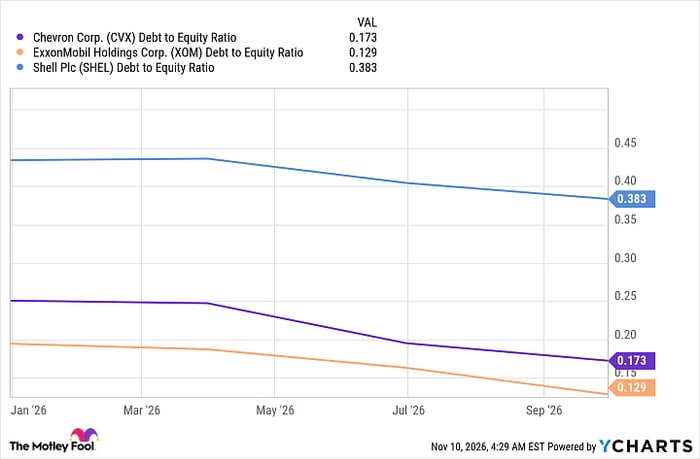
CVX Debt to Equity Ratio data by YCharts
A key reason for Chevron's financial prudence is its inability to predict oil price movements. Management noted that oil prices ranged from $68 to $132, a huge $64-per-barrel spread in just the third quarter. Given that backdrop, it makes complete sense that balance sheet strength remains important. And since geopolitical conflict and investor sentiment around it are key drivers of oil prices today, being prepared for volatility is really the best thing any company can do.
Shell sees a slightly different future ahead
That said, there's a changing dynamic in the global energy market that will likely linger long after the Middle East conflict ends. Shell, for example, has been in discussions with customers that range from companies to entire countries. And an increasingly important issue is energy security. Essentially, the conflict in the Middle East has increased the importance of having access to oil and natural gas that come from economically and politically stable regions.
Advertisement
To that end, Shell highlighted that it recently gave the green light to a large expansion of a liquefied natural gas export facility in Canada. That investment, made along with project partners, will double the size of the export facility. While the project won't be complete until the early 2030s, that actually speaks to the long-term change Shell expects in the market. And management clearly highlighted on its conference call that energy security issues may lead customers to be less price-conscious.
Where will oil go next? Who knows, but be prepared.
Unfortunately, there's really no clear way to know what happens next with oil prices. That's very clear when you examine what Exxon, Chevron, and Shell are saying. However, for investors, the bigger takeaway is that these global energy giants are preparing for continued uncertainty. Being in a state of flux isn't easy, but Exxon, Chevron, and Shell are all preparing for the immediate impact of that uncertainty and the long-term changes it may bring to the global energy market.
Should you buy stock in ExxonMobil right now?
Before you buy stock in ExxonMobil, consider this:
The Motley Fool Stock Advisor analyst team just identified what they believe are the 10 best stocks for investors to buy now… and ExxonMobil wasn’t one of them. The 10 stocks that made the cut could produce monster returns in the coming years.
Consider when Netflix made this list on December 17, 2004... if you invested $1,000 at the time of our recommendation, you’d have $341,157!* Or when Nvidia made this list on April 15, 2005... if you invested $1,000 at the time of our recommendation, you’d have $1,037,753!*
Now, it’s worth noting Stock Advisor’s total average return is 834% — a market-crushing outperformance compared to 207% for the S&P 500. Don't miss the latest top 10 list, available with Stock Advisor, and join an investing community built by individual investors for individual investors.
See the 10 stocks »
*Stock Advisor returns as of November 11, 2026.
Reuben Gregg Brewer has no position in any of the stocks mentioned. The Motley Fool has positions in and recommends Chevron. The Motley Fool has a disclosure policy.
Source: “AOL Money”
